






Hair loss is one of those concerns that people put off addressing until it becomes impossible to ignore. When they finally start researching, the treatment landscape feels overwhelming, especially now, with a newer option called exosome therapy sitting alongside the more established PRP (Platelet-Rich Plasma) in an increasing number of UK clinics. Both are injectable, regenerative treatments. Both claim to stimulate hair regrowth without surgery. But they work in fundamentally different ways, carry very different price tags, and have different levels of clinical proof behind them.
This guide gives you a clear, honest comparison so you can walk into a clinic consultation knowing exactly what questions to ask and which treatment makes sense for your situation.
PRP Hair Treatment: The Established Option
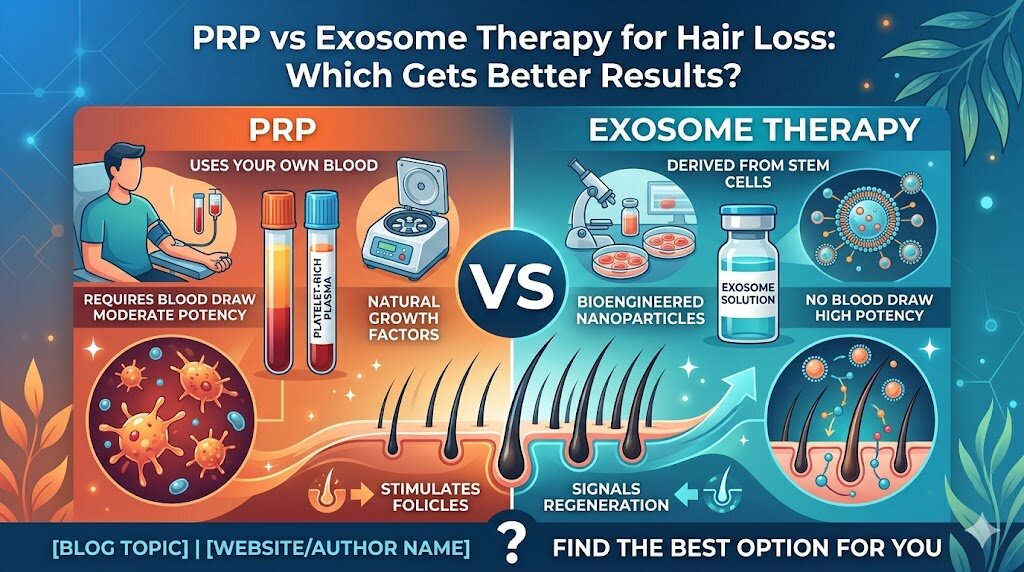
PRP has been used in medical and aesthetic settings for over two decades. For hair loss, the process starts with a simple blood draw, typically 10 to 20 ml from your arm. That blood is spun in a centrifuge to separate and concentrate the platelets, which are rich in growth factors. The resulting platelet-rich plasma is then injected directly into the scalp across the thinning areas.
The growth factors released by the platelets, including PDGF, VEGF, and IGF, signal dormant or weakened hair follicles to shift back into their active growth phase. PRP does not create new follicles where none exist, but it can meaningfully extend the life and density of follicles that are thinning due to androgenetic alopecia (the most common cause of hair loss in both men and women), stress-related shedding, or early alopecia areata.
A typical PRP course in the UK involves three to six monthly sessions, followed by maintenance treatments every six to twelve months. Results become visible at around three to four months, with the most significant improvement typically seen at six months. The treatment is well-suited to people in the early to mid stages of hair thinning, before significant follicle death has occurred.

Exosome Hair Therapy: The Newer Contender
Exosomes are nano-sized vesicles, essentially tiny messaging packets, secreted by cells as part of natural cell-to-cell communication. In aesthetic medicine, the exosomes used for hair loss are typically derived from stem cells (most commonly mesenchymal stem cells) in laboratory conditions, then processed, purified, and packaged into an injectable solution.
Where PRP delivers a relatively broad mix of growth factors from your own platelets, exosomes carry a far more concentrated and complex biological payload: thousands of growth factors, micro-RNA signals, proteins, and lipids that can directly influence how follicle cells behave at a genetic level. Think of PRP as sending a general growth signal to the scalp. Exosomes send thousands of highly specific instructions at once.
Clinical data on exosome hair therapy is still emerging, it does not have the two-decade evidence base that PRP holds, but early peer-reviewed studies and real-world clinic results are consistently positive. Many practitioners report faster visible onset of results compared to PRP, with some patients noticing changes within eight to twelve weeks. Because exosome treatments do not require a blood draw, the procedure is also slightly simpler from a patient experience perspective, though the injection protocol at the scalp is similar.
The most commonly used exosome preparations in UK clinics are derived from human placental or bone marrow mesenchymal stem cells. Some clinics use plant-derived exosome preparations, which are significantly cheaper but carry less clinical evidence in the context of hair loss specifically. Always ask what the source of the exosomes is before treatment.

PRP vs Exosome Hair Loss: Full Comparison
| Factor | PRP Hair Treatment | Exosome Hair Therapy |
| What it uses | Your own platelet-rich plasma | Lab-derived cell signalling vesicles |
| Mechanism | Growth factors stimulate dormant follicles | Thousands of growth factors + mRNA signals |
| Evidence base | Strong, 20+ years of clinical data | Emerging, promising early trials |
| Sessions needed | 3–6 sessions, monthly intervals | 1–3 sessions, spaced 4–6 weeks apart |
| Results visible | 3–6 months | 8–16 weeks (faster onset reported) |
| Longevity | 12–18 months before top-up | 12–24 months (early data) |
| Pain level | Mild, numbing cream applied | Mild, similar injection protocol |
| Downtime | 24–48 hrs (minor scalp sensitivity) | 24–48 hrs (similar) |
| Allergy risk | Very low, autologous (your own blood) | Low, no blood draw; donor-derived |
| UK cost per session | £200–£500 | £500–£1,500 |
| Best for | Established hair thinning, proven approach | Advanced thinning, faster response sought |
Data based on published clinical literature and UK clinic pricing as of Q1 2026. Individual results vary.
Which Treatment Is Right for You?
Choose PRP if:
- You are in the early to mid stages of hair thinning and want a clinically proven, well-researched approach
- Your budget is a key consideration, PRP is significantly more affordable per session
- You prefer a treatment that uses your own biological material with no donor-derived components
- You have androgenetic alopecia (male or female pattern hair loss) or stress-triggered shedding
Choose Exosome therapy if:
- You have tried PRP without sufficient results and want to try a more potent biological signal
- You want faster visible results and can absorb the higher cost per session
- Your hair thinning is more advanced and you need a stronger regenerative stimulus
- You are exploring the most cutting-edge regenerative options available in UK clinics
For women experiencing hair thinning linked to perimenopause or hormonal shifts, both treatments are used, but PRP has the longer track record specifically for female-pattern hair loss. Exosome therapy is gaining ground fast in this demographic. Either way, the hair loss treatment landscape in the UK continues to evolve rapidly in 2026, and a consultation with a specialist who offers both gives you the most balanced recommendation.
Cost in the UK: What to Budget
PRP hair treatment in the UK typically costs between £200 and £500 per session. A full initial course of three to six sessions puts the total investment between £600 and £3,000, plus annual or biannual maintenance treatments. London and premium clinics sit toward the upper end; regional UK clinics are generally more affordable.
Exosome hair therapy is a premium treatment. Single sessions range from £500 to £1,500 in the UK, with the variation reflecting the source and concentration of the exosome preparation used. Because fewer sessions are typically required, the total course cost can be comparable to PRP over the first year, but the per-session commitment is higher.
One practical point worth noting: because exosome therapy is newer and unregulated as a standalone category in the UK, quality varies considerably between providers. The source of the exosome preparation, its concentration (measured in particles per millilitre), and the storage and handling protocols all affect efficacy. A very cheap exosome treatment is almost always a lower-quality product. This is a treatment where transparency from the clinic matters more than price.
Quick Answers: PRP vs Exosome Hair Loss
Is exosome therapy better than PRP for hair loss?
Not definitively, yet. Exosome therapy delivers a more complex regenerative signal and may produce faster results, but PRP has two decades of clinical evidence behind it. Exosomes are the stronger option for advanced thinning or PRP non-responders. For most people starting treatment, PRP remains the safer and more cost-effective first choice.
How many PRP sessions do I need for hair growth?
Most UK clinics recommend 3 to 6 monthly sessions as an initial course, followed by maintenance every 6 to 12 months. Visible improvement typically begins at 3 to 4 months.
How long do exosome hair therapy results last?
Early clinical data suggests 12 to 24 months per course, potentially longer than PRP. The evidence base is still growing, so individual results vary more than with established PRP protocols.
Can PRP and exosomes be combined?
Yes. Some UK clinics combine both in a single scalp treatment, PRP as the growth factor base, exosomes as a concentrated booster on top. Early results from combined approaches are promising, though the cost is higher.
How much does PRP hair treatment cost in the UK?
Between £200 and £500 per session. A typical 3–6 session course costs £600 to £3,000 in total. London clinics charge more than regional providers.
Does exosome therapy hurt?
The scalp injection process is similar to PRP, a topical numbing cream is applied beforehand. Most patients rate discomfort as mild. There is no blood draw with exosome therapy, which some patients find more comfortable than PRP.
Are exosome hair treatments safe in the UK?
Exosome preparations from reputable, quality-assured laboratories are considered safe. As an unregulated category in the UK, standards vary between providers. Always ask for the source, particle concentration, and storage protocols of the specific preparation being used.
Which is better for female hair loss, PRP or exosomes?
PRP has the strongest evidence specifically for female-pattern hair loss and perimenopause-related thinning. Exosomes are increasingly being used in this demographic with encouraging early results. A specialist assessment is the most reliable way to determine which suits your specific type of hair loss.
The Verdict
PRP is proven, accessible, and well-suited to most people dealing with early or moderate hair thinning. It is the logical starting point and remains the clinical benchmark in regenerative hair treatments.
Exosome therapy is the more potent and potentially faster-acting option, the treatment to consider if PRP has underdelivered or if more advanced thinning requires a stronger biological signal. Its evidence base is improving rapidly and it is likely to become the dominant approach in regenerative hair medicine within the next few years.
The honest answer for most people: start with PRP, assess your response at six months, and move to exosomes if you want stronger results or faster progression. If budget is not a constraint and you want the most advanced available, exosome therapy is worth exploring now, with a clinic that can demonstrate product quality and practitioner experience.
