





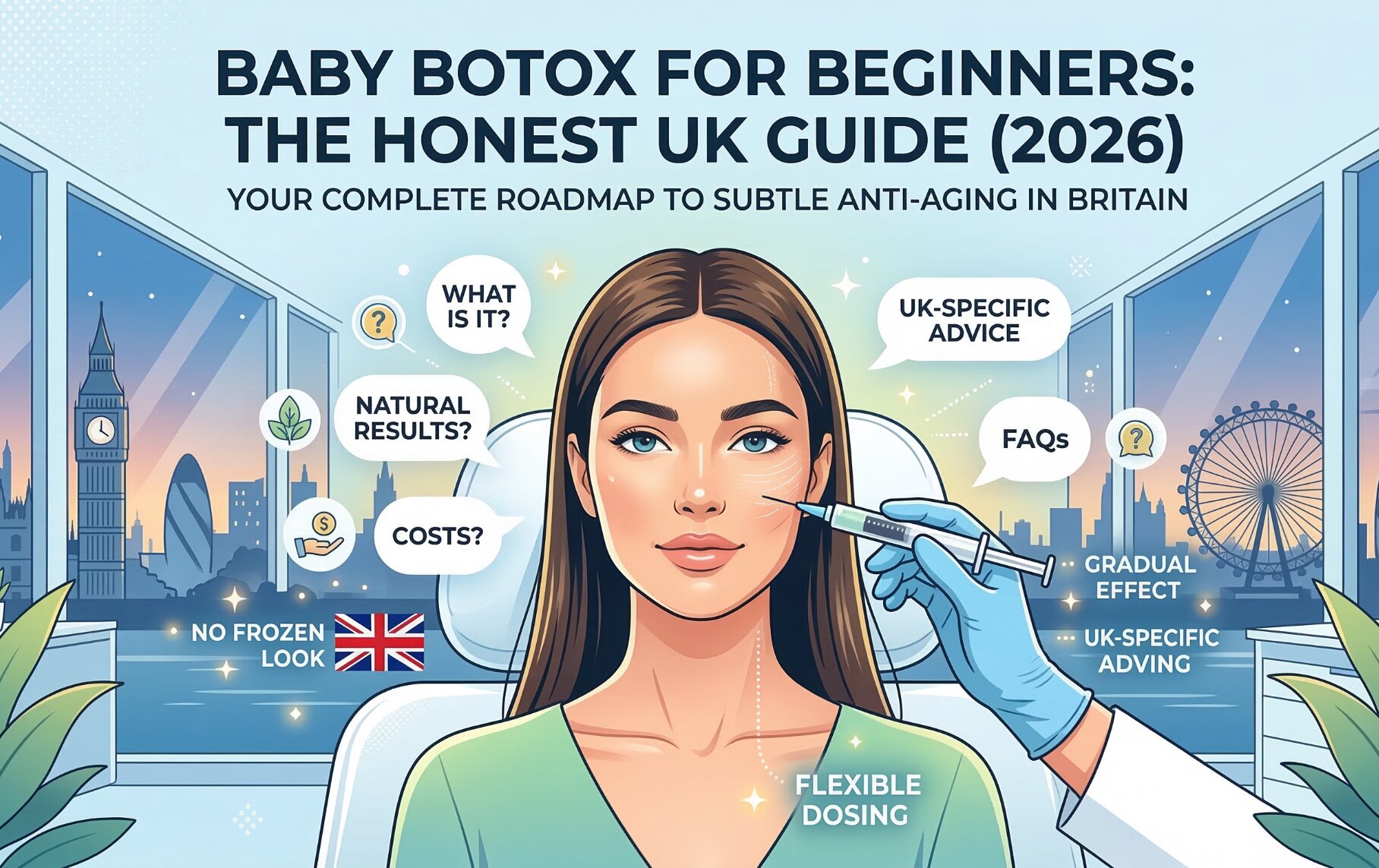
Baby Botox is one of the most searched aesthetic treatments in the UK right now, and it is easy to see why. Whether you are in your mid-twenties and thinking about preventative measures, or simply someone who has always been curious about Botox but feared looking overdone, baby Botox sits neatly in the middle of the conversation. It promises all the freshness without the frozen forehead. But what is it actually, how does it differ from regular Botox, how long do results last, and how much will it genuinely cost you at a UK clinic in 2026?
This guide answers every real question beginners ask, in plain language, without the clinic-speak. It also covers the most important regulatory changes affecting Botox treatments in the UK right now, which matter more than ever if you are booking for the first time.
What Is Baby Botox? (And What It Is Not)
Baby Botox is not a specific branded product or a different formulation. It is exactly the same botulinum toxin used in standard Botox treatments, just administered in significantly smaller doses and with greater precision in placement. You might also hear it called micro Botox, mini tox, or preventative Botox depending on the clinic and the context.
A regular Botox treatment for the forehead might use fifteen to twenty-five units of botulinum toxin per area. Baby Botox typically uses around six to twelve units in the same zone. The result is a treatment that softens muscle activity and smooths early lines while still allowing your face to move, smile, frown, and express freely. No freezing, no telltale stiffness, and no obvious signs you have had anything done.
The term has nothing to do with age or treating babies. It refers entirely to the dose. Clinicians sometimes use the phrase prejuvenation Botox to describe the same concept when the aim is specifically to prevent lines from forming rather than treating established ones.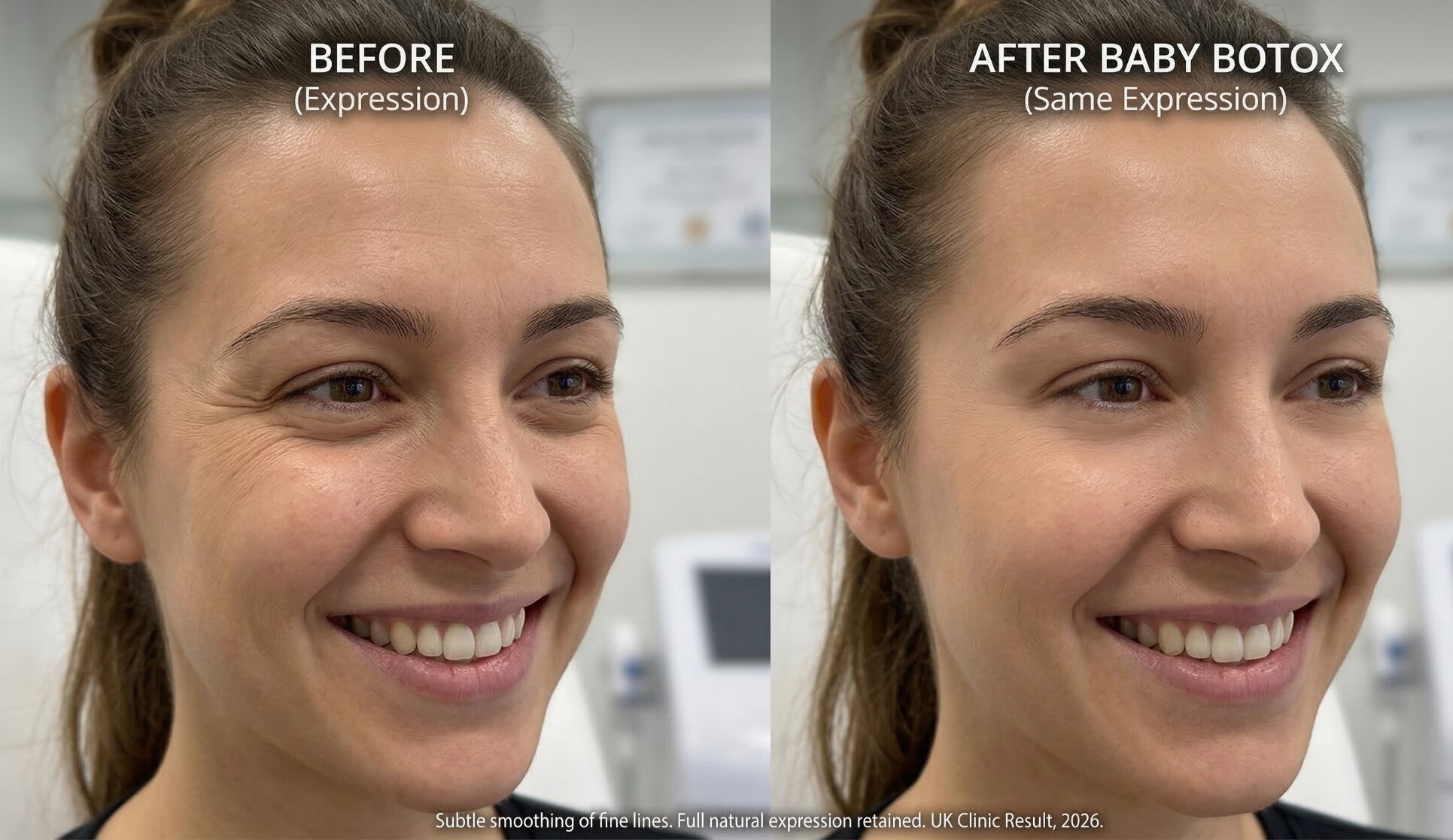
How Does Baby Botox Actually Work?
Botulinum toxin works by temporarily blocking the nerve signals that tell your facial muscles to contract. When you squint, raise your brows, or furrow in concentration, repeated muscle movement over years is what causes dynamic wrinkles to deepen into permanent lines. By reducing the intensity of those contractions with a small, targeted dose, baby Botox prevents that deepening without switching off movement entirely.
With a full standard dose, the muscle is more significantly restricted. With baby Botox, you are dialling the muscle back rather than turning it off. This makes the treatment especially popular for areas where natural expression matters most, such as:
- The forehead – preventing horizontal lines from deepening
- The glabella (the eleven lines between the brows) – softening frowning without eliminating the ability to show concern
- Crow’s feet around the eyes – reducing the fan of lines without giving a wide, unblinking look
- Bunny lines on the nose – for those who wrinkle at the top of the nose when they smile
- The lip area – very small doses to soften fine vertical lines above the upper lip
Because lower doses are used, sessions tend to be quicker, with most appointments taking twenty to thirty minutes including consultation and aftercare guidance.
Baby Botox vs Regular Botox: What Is Actually Different?
The most common question from first-timers is whether baby Botox is actually worth having when you could just have regular Botox. Here is a clear side-by-side breakdown:
| Factor | Baby Botox | Regular Botox |
| Units used (typical) | ~6–12 units per area | ~15–25 units per area |
| Results timeline | Kicks in within 5–10 days | Kicks in within 5–14 days |
| Expression retained? | Yes – full movement preserved | Reduced – some freezing possible |
| How long results last | 2–4 months (shorter) | 3–6 months |
| Best suited to | 20s–30s, first-timers, subtle results | Established lines, stronger muscles |
| Risk of ‘frozen look’ | Very low | Low to moderate if overdosed |
| Downtime | Minimal – back to normal same day | Minimal – same |
| Average UK cost | £80–£220 (lower units = lower cost) | £150–£350 per area |
| Preventative use | Ideal – prejuvenation approach | Less common at early stage |
Figures based on UK clinic data as of early 2026. Individual results vary based on muscle strength, metabolism, and practitioner technique.
One important nuance: because baby Botox uses fewer units, the results wear off faster, often within two to four months compared to three to six months for a standard dose. This means you may need to return for top-ups slightly more frequently, which can affect the overall annual cost. However, for many clients in their twenties and early thirties, the trade-off is worth it for the more natural outcome.
Want to understand how Botox fits within the broader range of non-surgical options available in the UK? Our overview of the best non-surgical treatments for facial rejuvenation covers everything from skin boosters to thread lifts.
Who Is Baby Botox For? Am I a Good Candidate?
People in Their 20s Considering Preventative Botox
Preventative Botox in your twenties is no longer unusual in the UK. The thinking behind it is sound: it is easier to slow the formation of lines than to reverse them once they are established. For people in their mid to late twenties who are starting to notice early dynamic lines (the kind that appear when your face moves but fade when relaxed), baby Botox as a prejuvenation strategy is a well-recognised approach in UK aesthetics medicine.
The key is starting conservatively. You do not need significant volume of product at this stage. A skilled practitioner will use the minimum effective dose to slightly reduce repetitive muscle activity, which over time helps prevent those shallow lines from becoming deep-set creases.
First-Time Botox Users Who Want a Subtle Introduction
If you have always been curious about Botox but worried about looking ‘done’, baby Botox is widely regarded as the most appropriate entry point. The smaller dose gives both you and your practitioner valuable information about how your muscles respond to the toxin, allowing for adjustments at subsequent appointments. Many practitioners actively recommend starting low and building gradually rather than going straight to a full dose.
Anyone Who Wants Natural-Looking Results
Baby Botox is not exclusively for younger clients. Plenty of people in their thirties and forties use it specifically because they want visible improvement without the social tell of looking expressionless. If you are camera-facing, work in public-facing roles, or simply value looking like yourself only more rested, the micro-dose approach can deliver that balance particularly well.
Who Should Not Have Baby Botox
Baby Botox is not suitable for everyone. The following groups should not have the treatment:
- Pregnant or breastfeeding women
- Anyone with a diagnosed neuromuscular condition such as myasthenia gravis or Lambert-Eaton syndrome
- People with known allergy to botulinum toxin or any ingredient in the formulation
- Anyone under the age of 18 (illegal in the UK for cosmetic purposes)
- Those with active skin infections or inflammation in the treatment area
A qualified practitioner will always complete a medical history review and full consultation before treatment. Under updated UK regulations since 2025, a mandatory in-person consultation with a prescribing clinician is required before any botulinum toxin can be administered.
Your First Appointment: What to Expect Step by Step
Many first-timers worry about the experience itself. Here is a straightforward walk-through of what a baby Botox appointment at a reputable UK clinic looks like in 2026:
1. Consultation
Before any treatment, a prescribing practitioner (a doctor, dentist, nurse prescriber, or pharmacist independent prescriber) must assess your medical suitability. Since January 2025, NMC-registered nurse prescribers are required to do this in person rather than remotely. You will be asked about your medical history, medications, allergies, and what results you are hoping for. Photos are typically taken for your records.
2. Facial Assessment
The practitioner will observe your face in motion, asking you to raise your brows, frown, squint, and smile. This maps out the exact muscles to be targeted and allows the practitioner to plan the precise injection points and the minimal dose needed for your specific anatomy.
3. The Injections
A topical numbing cream may be applied if you prefer it, though most clients find the injections quick enough that numbing is optional. A very fine needle is used and each injection takes only a second. For a baby Botox forehead treatment, you might have four to six injection points across the forehead and two to three either side of the eyes for crow’s feet. The whole thing typically takes ten to fifteen minutes.
4. Aftercare Guidance
After treatment you will be advised to remain upright for at least four hours, avoid strenuous exercise and alcohol for twenty-four hours, and not massage or apply pressure to the treated area. Most people return to work, social plans, or daily activities the same day.
5. The Two-Week Review
Good clinics offer a follow-up review at two weeks. At this point the results have fully settled and the practitioner can assess whether a small top-up is warranted. For baby Botox at conservative doses, this is particularly useful to ensure the result is exactly where you want it without needing to wait until a full repeat session.
Baby Botox Results: How Long Do They Last?
This is the question searched most often alongside baby botox results how long, and the honest answer is: slightly less than standard Botox.
Because you are using fewer units, the muscle-blocking effect is gentler and the product metabolises faster. Most people find that baby Botox results last between two and four months. Some individuals with stronger facial muscles or faster metabolisms may find it wears off closer to the eight-week mark. Others who are more sedentary or who have been having regular treatments for some time may find results extend closer to four to five months as the muscles become conditioned.
Factors that influence longevity include:
- Muscle strength and size – stronger muscles (common in men and expressive faces) metabolise the product faster
- Metabolism – people with higher metabolic rates tend to break down the toxin more quickly
- Exercise frequency – very high intensity exercise can reduce duration slightly
- Sun exposure – UV damage to skin can affect how long results appear fresh
- Dose used – naturally, a slightly higher micro-dose will last a little longer than the minimum
Most practitioners recommend scheduling your next baby Botox appointment at the three-month mark to maintain consistent results before the previous treatment fully wears off.
How Much Is Baby Botox in the UK? Realistic 2026 Pricing
Pricing for baby Botox in the UK is lower than regular Botox precisely because fewer units of product are used. However, costs vary significantly depending on your location, the experience of the practitioner, and whether the clinic charges per area or per unit.
| Location | Baby Botox (per session est.) | Regular Botox (1–2 areas est.) |
| London – standard clinic | £100–£200 | £200–£350 |
| London – Harley St / premium | £180–£300+ | £300–£500+ |
| Manchester / Birmingham | £80–£170 | £150–£280 |
| Scotland & Wales | £70–£150 | £120–£250 |
| UK average (all regions) | £80–£180 | £150–£320 |
Pricing based on publicly available UK clinic data, Q1 2026. Always confirm costs directly with your chosen clinic before booking.
Some clinics charge per unit (typically £8 to £15 per unit at reputable UK clinics), which makes baby Botox very transparent to price. If a practitioner uses ten units across your forehead and crow’s feet at £10 per unit, your session costs £100. Others charge by area treated, which may make comparison harder.
The lowest prices you see advertised online, sometimes as low as £50 or £60, are a serious red flag. In July 2025, 38 confirmed botulism cases in England were linked to suspected use of unlicensed Botox-like products in cosmetic procedures. This is the very real danger of choosing providers on price alone. Botulinum toxin must be a licensed prescription-only medicine from a regulated manufacturer such as Allergan (Botox), Galderma (Azzalure), or Merz (Bocouture).
For more guidance on navigating aesthetic treatments safely and making smart decisions for your money, see our article on how to choose the right aesthetic clinic in the UK.
UK Botox Regulations in 2026: What You Need to Know Before You Book
The UK aesthetics industry is in the middle of its biggest regulatory overhaul in decades, and if you are a first-time client, this directly affects how you should research and book your baby Botox treatment.
Here is what has changed and what is still changing:
- Since January 2025, NMC-registered nurse prescribers must conduct in-person consultations before prescribing botulinum toxin. Remote prescribing for Botox is no longer compliant for nurses and midwives.
- The Health and Care Act 2022 gave the UK Government powers to introduce a national licensing scheme for non-surgical cosmetic procedures in England. In August 2025, the government confirmed this will go ahead, with a further public consultation expected in early 2026.
- Under the proposed red, amber and green risk framework, Botox is expected to sit in the amber category, meaning practitioners who are not regulated healthcare professionals will need to operate under the oversight of a named regulated clinician.
- Under the Botulinum Toxin and Cosmetic Fillers (Children) Act, it is already illegal to administer Botox for cosmetic purposes to anyone under 18 in the UK.
- Scotland is expected to introduce its own Non-surgical Cosmetic Procedures Bill before May 2026, setting a precedent for UK-wide tighter standards.
What this means for you as a client: always verify that your chosen practitioner is registered with the GMC, GDC, NMC, or GPhC, and check voluntary registers such as Save Face or the Joint Council for Cosmetic Practitioners (JCCP). These standards are your strongest protection right now while formal licensing is still being finalised.
Explore more health and lifestyle guidance on The Business Brew for regularly updated content on UK aesthetics, wellness, and beauty industry developments.
Baby Botox Aftercare: Making Your Results Last
Good aftercare helps you get the most from each treatment. Here are the evidence-backed steps practitioners consistently recommend:
- Stay upright for at least four hours after treatment to prevent product migration
- Avoid rubbing or massaging the treated area for twenty-four hours
- Skip strenuous exercise, saunas, and steam rooms for twenty-four to forty-eight hours
- Avoid alcohol on the day of treatment as it increases bruising risk
- Apply SPF daily to the treatment area – UV exposure accelerates skin ageing and can affect how long results feel fresh
- Keep well hydrated and maintain a consistent skincare routine with ingredients like retinol (used at night), vitamin C, and hyaluronic acid serums to support skin quality between treatments
- Book your next session at around the two-and-a-half to three-month mark before the product fully wears off for the most consistent maintenance
For more on building a skincare routine that complements aesthetic treatments, read our guide to anti-ageing skincare for every budget in the UK.
Frequently Asked Questions
1. What is the minimum age for baby Botox in the UK?
You must be 18 or over. Under the Botulinum Toxin and Cosmetic Fillers (Children) Act, it is illegal to administer Botox for cosmetic purposes to anyone under 18 in the UK. Any clinic willing to treat someone younger is operating outside the law.
2. Is baby Botox safe for a complete beginner?
Yes, when performed by a qualified and registered practitioner using licensed products, baby Botox is considered safe for first-timers. In fact, starting with a lower dose is widely recommended for beginners precisely because it allows you to assess how your muscles respond before committing to higher doses. Always ensure your practitioner holds a valid registration with the GMC, NMC, GDC, or GPhC.
3. Does baby Botox hurt?
Most clients describe the injections as a mild pinching or stinging sensation that lasts a second or two per injection point. The needles used are very fine. Topical numbing cream is available at most clinics if you are particularly sensitive, though many clients find it unnecessary for such a quick procedure.
4. How long does baby Botox take to work?
You will typically start to notice results within three to five days as the muscles begin to relax, with full effects visible at around ten to fourteen days. Results continue to settle during this two-week period, which is why the follow-up review appointment matters.
5. Can I have baby Botox if I am getting it for the first time in my 20s?
Yes, and many practitioners actively support the use of baby Botox as a preventative strategy in the mid to late twenties. The goal at this stage is not to treat deep wrinkles but to slow their formation by gently reducing repetitive muscle movement before lines become permanently etched. You do not need to wait until wrinkles appear to explore this approach.
6. How much does baby Botox cost in London?
In London, baby Botox typically costs between £100 and £200 at standard clinics, and between £180 and £300 or more at premium practices on Harley Street or in Mayfair. Some clinics charge per unit, usually between £8 and £15 per unit, which can be more transparent. Always avoid unusually cheap offers, as unlicensed products are a genuine documented risk in the UK.
Final Thoughts: Is Baby Botox Right for You in 2026?
Baby Botox has become one of the most accessible and widely accepted entries into aesthetic treatment in the UK, and for good reason. The approach is measured, the results are natural, and the concept of working with your face rather than overriding it resonates with a generation of clients who want to look like themselves at their best.
For first-timers, people in their twenties thinking about prevention, and anyone who has always been curious but nervous, the smaller dose removes most of the common objections. The risk of looking overdone is minimal when the treatment is done well. The key word, as always, is well. Practitioner skill, proper licensing, and a thoughtful approach to dosing matter more than the name of the treatment.
Use the UK’s new regulatory expectations as your guide when booking. A clinic that requires a face-to-face consultation, uses licensed products from recognised manufacturers, and offers a two-week review is starting from the right place. That is your baseline in 2026, not a premium.