




Two treatments dominate the non-surgical skin tightening conversation at UK aesthetics clinics right now: Morpheus8 and HIFU. Both promise a firmer, lifted face without going under the knife. Both are backed by solid clinical science. Both carry a price tag that demands a well-informed decision before you book. But they work through completely different technologies, target different depths of tissue, and suit different skin concerns, and choosing the wrong one for your specific goals can mean spending over a thousand pounds on results that are only partially right for you.
This guide explains exactly how each treatment works, gives you an honest side-by-side comparison, and tells you clearly who should choose which based on what your skin actually needs in 2026.
What Is Morpheus8 and How Does It Work?
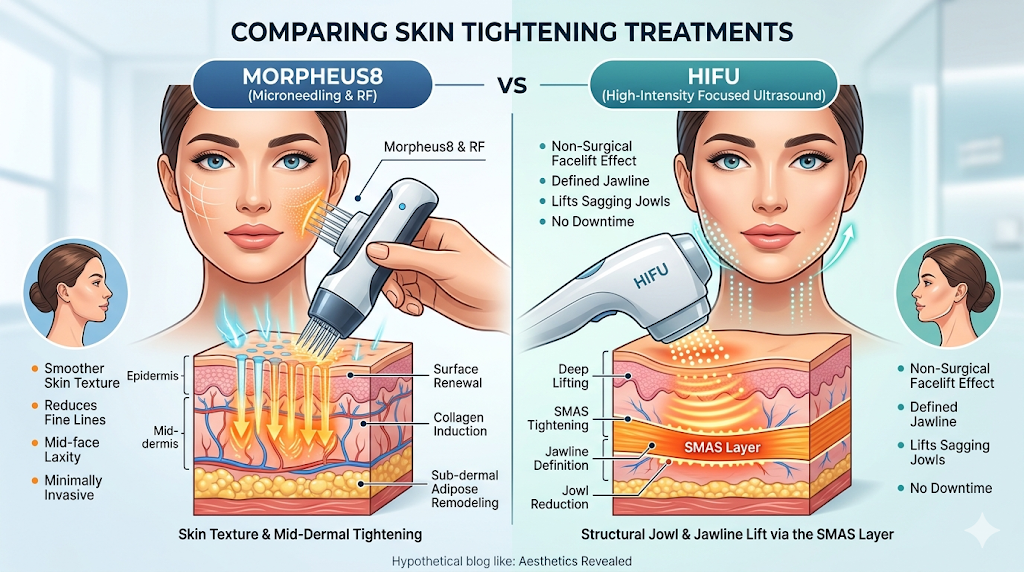
Morpheus8 is a minimally invasive fractional RF microneedling device by InMode that combines two technologies simultaneously: microneedling and radiofrequency energy. A matrix of 24 coated micro-pins penetrates the skin at programmable depths between 1.5 mm and 8 mm, delivering RF heat directly into the dermis and subdermal tissue at the moment of penetration.
This creates two simultaneous effects. The physical punctures trigger the skin’s wound-healing response, stimulating new collagen and elastin. The RF heat contracts existing collagen fibres immediately and drives further new collagen formation over the following months. At deeper settings, the energy reaches and gently remodels the subdermal fat layer, producing a sculpting and contouring effect alongside the tightening.
Because the energy is delivered beneath the surface through insulated needles rather than via light or heat applied to the skin’s surface, Morpheus8 works safely on all skin tones including darker complexions, a significant advantage over laser-based alternatives. Areas routinely treated include the lower face, jowls, neck, under-eye skin, abdomen, arms, knees, and inner thighs. It is one of very few non-surgical devices that treats the face and body with equal efficacy in a single platform.
What Is HIFU and How Does It Work?
HIFU, High-Intensity Focused Ultrasound, is a fully non-invasive treatment. No needles, no skin penetration. Instead, it delivers focused ultrasound energy through the skin’s surface to precise target depths, using an acoustic lens to concentrate thermal coagulation points exactly where needed beneath the surface.
HIFU’s defining capability is reaching the SMAS layer, the superficial muscular aponeurotic system, at a depth of 4.5 mm. This is the same fibromuscular layer tightened during a surgical facelift. By creating controlled heating points within this layer, HIFU triggers genuine contraction and structural lifting that surface-level treatments cannot replicate. It simultaneously stimulates collagen production throughout the dermis, producing a gradual lifting effect that builds over three to six months.
Well-known HIFU devices used in UK clinics include Ultherapy (FDA-cleared with real-time ultrasound imaging), Ultraformer III, and Ultracel. Ultherapy’s imaging capability allows practitioners to visualise the tissue layer being targeted in real time, the benchmark for precision in this category. For a broader comparison including newer technology entering the UK market, see our guide on Sofwave vs Morpheus8 vs Ultherapy: the 2026 skin tightening showdown.
Morpheus8 vs HIFU: Side-by-Side Comparison
Here is a clear breakdown of both treatments across every factor that matters when making this decision at a UK clinic in 2026:
| Factor | Morpheus8 | HIFU |
| Technology | RF energy via microneedles | Focused ultrasound waves |
| Key target layer | Dermis + subdermal tissue (1.5–8 mm depth) | SMAS layer (1.5–4.5 mm depth) |
| Improves skin texture? | Yes, pores, scars, tone, fine lines | Minimal, primarily lifts |
| Targets SMAS layer? | Indirectly via deep RF | Yes, primary strength |
| Body areas treatable? | Face, neck, abdomen, arms, knees, thighs | Mainly face and neck |
| Results visible | 2–3 weeks; peaks at 3–6 months | 3–6 months post-treatment |
| Longevity | 12–18 months (up to 3+ yrs with maintenance) | 12–24 months per session |
| Sessions needed | 1–3 (face); 3–4 (body) | 1 session (annual top-up) |
| Downtime | 2–5 days (redness, micro-scabbing) | None to minimal |
| Pain level | Moderate, numbing cream applied | Mild, warmth and tingling |
| Skin tone suitability | All skin types including darker tones | All types; care for darker tones |
| UK cost per session (face) | £600–£1,200 | £400–£900 |
| Best for | Texture + tightening + contouring combined | Deep structural jowl/neck lift |
Specifications based on published clinical data and UK clinic standards, Q1 2026.
The Core Difference: Resurfacing vs Structural Lifting
The most useful way to understand the difference between these two treatments is this: Morpheus8 improves skin from the dermis outward. HIFU lifts skin from the SMAS layer upward. Both produce a tighter, more youthful appearance, but via entirely different mechanisms.
Morpheus8 is the stronger choice when skin quality is part of the concern. If you have visible pores, acne scarring, surface roughness, fine lines, or crepey texture alongside laxity, Morpheus8 addresses all of it in a single treatment. Its ability to reach subdermal fat also makes it effective for mild jowling and contouring in the lower face. For the body, arms, abdomen, knees, it is the clear leader, as HIFU has limited meaningful efficacy outside the face and neck.
HIFU is the stronger choice when the primary concern is structural. If your skin surface quality is reasonably good but the face has lost its definition at the jawline, the jowls are softening, or the neck is developing laxity, HIFU’s SMAS-targeting ability produces a more direct structural lift than RF microneedling can match. The depth it reaches is the mechanism of a surgical facelift, delivered without incisions.
Where HIFU falls short: it does relatively little for skin texture, pore size, fine epidermal lines, or surface-level skin quality. Patients who feel their skin looks dull or tired as well as sagging will find HIFU addresses only half of the picture.
Many experienced UK practitioners now recommend combining both: HIFU for the deep structural lift, Morpheus8 for the surface refinement. Each treatment does precisely what the other cannot. For more on what non-surgical options exist for different facial concerns, see our overview of the best non-surgical face treatments available in the UK.
Morpheus8 vs HIFU Cost UK 2026
Both treatments represent a significant investment. Here is an honest breakdown of what UK clinics charge in 2026:
| UK Location / Tier | Morpheus8 Face (per session) | HIFU Full Face & Neck (per session) |
| London – standard clinic | £700–£1,000 | £500–£800 |
| London – Harley St / premium | £1,000–£1,800 | £800–£1,400 |
| Manchester / Birmingham | £550–£900 | £400–£700 |
| UK regions (average) | £600–£900 | £400–£650 |
| 3-session face package (avg.) | £1,800–£2,800 | N/A (typically annual single) |
Source: publicly available UK clinic pricing, Q1 2026. Request a formal written quote at consultation.
Morpheus8 costs more per session because the procedure uses single-use consumable tips (replaced for every patient), takes longer, and requires more operator skill to calibrate depth and energy settings correctly. A full three-session Morpheus8 face course at a reputable UK clinic typically totals between £1,800 and £2,800, with London premium practices reaching higher. HIFU, while lower per session, delivers its primary result in a single annual or biannual treatment, making the annual cost broadly comparable for many patients.
One important warning on HIFU pricing: treatments advertised at £150 to £300 are almost always performed on low-grade devices without the imaging capability of premium systems. Budget HIFU devices cannot confirm they are reaching the SMAS layer with precision. The difference in result quality reflects the difference in device quality. Always ask which specific HIFU device a clinic uses before booking.
For guidance on choosing a trustworthy UK aesthetics clinic for high-value treatments, visit The Business Brew for regularly updated resources on UK aesthetics safety and standards.
Safety and What to Watch Out For
Morpheus8 Side Effects
Expected and temporary: redness, swelling, and micro-scabbing at needle entry points lasting two to five days. Rare risk of hyperpigmentation in darker skin tones if device settings are not correctly calibrated. Infection risk is very low when post-treatment care instructions are followed. Always confirm the clinic is using the genuine InMode Morpheus8 device, there are cheaper RF microneedling devices on the UK market that do not share the same validated clinical data.
HIFU Side Effects
Milder on the surface: temporary tingling, numbness, or tenderness in the treated area lasting a few days to two weeks. Mild transient redness that typically resolves within hours. Rare cases of nerve-related discomfort around the cheek or jaw area. The key risk with HIFU in the UK is low-quality devices, always ask for the specific device name and confirm it is a CE-marked, validated system. Practitioners should hold appropriate registration with the GMC, NMC, GDC, or GPhC.
Frequently Asked Questions
1. Which is better for the face, Morpheus8 or HIFU?
It depends entirely on your primary concern. If you have skin texture issues alongside laxity, pores, scarring, fine lines, dull skin, Morpheus8 addresses both in one treatment. If your skin surface quality is good but you have structural sagging at the jowl or neck, HIFU’s SMAS-targeting ability delivers a more direct structural lift. Many practitioners recommend combining both for the most complete non-surgical outcome.
2. How long do Morpheus8 results last in the UK?
Following a two to three-session course, results typically last twelve to eighteen months. With a consistent SPF and skincare routine and occasional maintenance sessions, some patients maintain improvements for up to three years. Longevity depends on age, lifestyle, sun exposure, and the number of sessions completed.
3. How long does HIFU last?
A full HIFU treatment typically produces results lasting twelve to twenty-four months. Most clinics recommend an annual or biannual top-up to maintain the lift. Because the results build gradually as new collagen forms over three to six months, they tend to look natural and last in proportion to genuine structural tissue change.
4. Is Morpheus8 painful?
Most patients find Morpheus8 tolerable. A topical numbing cream is applied thirty to sixty minutes beforehand, and the sensation during treatment is described as light pressure with warmth. Some areas such as the jaw and around the mouth are more sensitive. Discomfort is generally manageable throughout the thirty to sixty-minute session.
5. Does HIFU have any downtime?
HIFU has minimal downtime for most patients. You can typically return to work and daily activities the same day. Some temporary redness or a tingling sensation lasting a few hours to a couple of days is common. This is one of HIFU’s primary practical advantages over Morpheus8, which requires two to five days of visible recovery.
6. How much does Morpheus8 cost in London?
In London, a single Morpheus8 face session costs between £700 and £1,000 at standard clinics and between £1,000 and £1,800 at premium or medically-led practices. A three-session course for the full face and neck averages £2,000 to £3,500. Package pricing at reputable providers reduces the per-session cost.
7. Can Morpheus8 be used on all skin tones?
Yes. This is one of Morpheus8’s most significant practical advantages. Because RF energy is delivered beneath the skin surface through insulated needles rather than via surface heat or light, it poses a very low risk of post-inflammatory hyperpigmentation in darker Fitzpatrick skin types when correctly calibrated. Always confirm your practitioner has experience treating your specific skin tone.
8. Can Morpheus8 and HIFU be done at the same time?
Most practitioners recommend spacing the treatments rather than same-day delivery. A common protocol is to complete a Morpheus8 course first, then introduce HIFU at a subsequent appointment to address the deeper structural lift. Some experienced clinics do offer combined protocols, but the standard approach is to separate them for comfort and to assess each treatment’s contribution to the result.
9. Which is better for the neck, Morpheus8 or HIFU?
Both are effective for the neck, but with different strengths. HIFU delivers a deeper structural lift for significant neck laxity and the early stages of a turkey neck, due to its SMAS-level targeting. Morpheus8 is preferred when the neck also has skin texture concerns, crepiness, or horizontal lines. For comprehensive neck rejuvenation, combining both produces the strongest outcome.
10. How do I find a safe Morpheus8 or HIFU clinic in the UK?
For Morpheus8, confirm the device is the genuine InMode Morpheus8 and that the practitioner is registered with the GMC, NMC, GDC, or GPhC. For HIFU, ask the specific device name, premium options include Ultherapy, Ultraformer III, and Ultracel. Avoid HIFU priced under £300. Look for clinics listed on Save Face or the Joint Council for Cosmetic Practitioners (JCCP) registers.
The Verdict: Morpheus8 vs HIFU in 2026
Choose Morpheus8 if your concern includes skin texture, pores, acne scarring, or crepey skin alongside laxity, or if you want to treat a body area. It is the most versatile single non-surgical device available in UK clinics.
Choose HIFU if your skin surface quality is good and your primary concern is structural jowl and neck lifting with zero downtime. It reaches depths that RF microneedling does not.
Consider both if you want the most complete non-surgical facial result available in 2026. A phased approach combining both technologies represents the current ceiling for non-surgical outcomes, each doing precisely what the other cannot.
Above all, choose your practitioner as carefully as you choose your treatment. These are precision devices and the results reflect the operator behind them as much as the technology.