







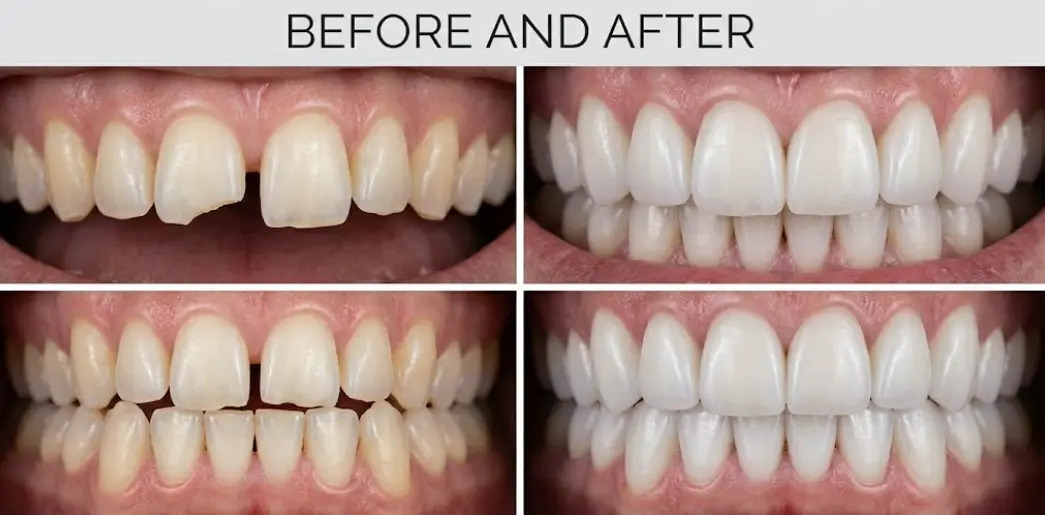
Composite bonding and veneers both transform smiles. Both fix chips, gaps, discolouration and uneven teeth. Both are available at private dental clinics across the UK. But they are not the same treatment, and choosing the wrong one can mean spending significantly more than you needed to, committing to an irreversible procedure before you were ready, or getting a result that doesn’t match what you actually wanted.
The honest difference comes down to four things: cost, longevity, reversibility, and the degree of transformation you need. This guide walks through all of them using real 2026 UK pricing, so you can make a properly informed decision before you sit in the dentist’s chair.
What Is Composite Bonding?
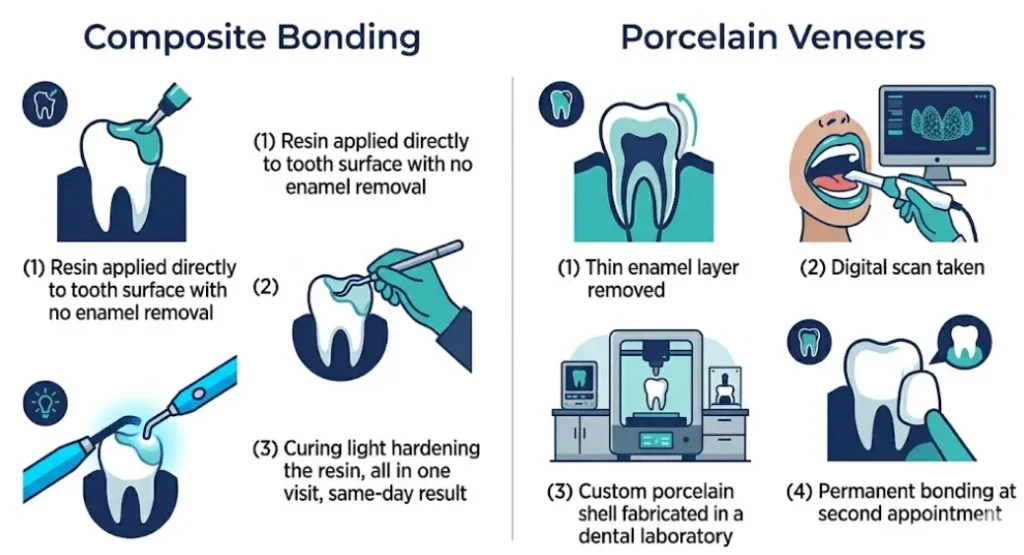
Composite bonding is a chairside cosmetic dental procedure where a tooth-coloured resin is applied directly onto the surface of your teeth, sculpted by hand, and hardened with a curing light, all in a single appointment. No laboratory work, no waiting weeks for results, no drilling in most cases. The dentist works freehand, building and shaping the resin against the tooth until it matches the desired size, shape and colour.
It is used to repair chipped or broken teeth, close small gaps between teeth, reshape teeth that are too short or uneven, cover surface staining that whitening cannot shift, and refine the overall symmetry of a smile. The resin bonds directly to the enamel surface, which means in most cases no enamel needs to be removed. This makes composite bonding largely reversible, if you change your mind later, the bonding can be removed and your natural teeth remain intact.
In the UK, composite bonding typically costs between £200 and £500 per tooth for private treatment, with most patients paying around £300–£350 per tooth at established practices. Edge bonding for minor chips can start from £100–£200 per tooth. Cosmetic bonding is not available on the NHS for smile enhancement; restorative bonding for clinically damaged teeth may qualify under a Band 2 charge (£75.30 as of April 2025).
What Are Porcelain Veneers?
Porcelain veneers are custom-made ceramic shells, fabricated in a dental laboratory, that are permanently bonded to the front surface of your teeth. Because they are made from high-grade porcelain, they very closely mimic the natural translucency and texture of tooth enamel, and they are highly resistant to staining from coffee, tea, and red wine in a way that composite resin is not.
The process requires at least two appointments. At the first, the dentist shaves a thin layer of enamel from each tooth being treated, typically around 0.3–0.5 mm, to create space for the veneer shell. Digital scans or physical impressions are taken and sent to the laboratory. Temporary veneers are fitted while the permanent ones are made. At the second appointment, the custom veneers are bonded in place.
The enamel removal step is the most important thing to understand about veneers: it is permanent and irreversible. Once enamel is removed, it does not grow back. Your teeth will always need some form of coverage going forward, if a veneer chips, cracks, or reaches the end of its lifespan, it must be replaced. This is the trade-off for the superior longevity and aesthetics that porcelain provides.
Porcelain veneers in the UK cost between £700 and £1,500 per tooth at private clinics in 2026, with London practices charging toward the higher end. A full set of six front teeth (the ‘social six’) typically costs £4,200–£9,000. Research shows that up to 95% of porcelain veneers remain functional after 10 years, with an 85% survival rate at 15 years.
Composite Bonding vs Veneers: Full Comparison
| Composite Bonding | Porcelain Veneers | |
| Material | Tooth-coloured resin, sculpted chairside | Custom ceramic shells, lab-fabricated |
| Appointments needed | 1 appointment (same-day result) | 2–3 appointments (2–4 weeks apart) |
| Enamel removal? | None in most cases, reversible | Yes, thin layer removed (irreversible) |
| Reversible? | Generally yes | No, permanent commitment |
| Longevity | 5–8 years with good care | 10–20 years with good care |
| Stain resistance | Moderate, porous; stains over time | High, ceramic is highly stain-resistant |
| Repairability | Chips repaired chairside, same visit | Broken veneer must be fully replaced |
| Best for | Minor chips, gaps, shape refinements | Major colour, shape or size transformation |
| Cost per tooth (UK 2026) | £200–£500 | £700–£1,500 |
| Social six (6 teeth) cost | £1,200–£3,000 | £4,200–£9,000 |
| Teeth whitening before? | Whiten first, resin matched to shade | Whiten first, porcelain matched to shade |
| Night guard needed? | Recommended for grinders | Essential for grinders |
| NHS available? | Only for clinical restorations (Band 2) | Rarely, cosmetic cases not funded |
UK pricing verified against multiple dental practice and independent dental guide sources, March 2026. Individual costs vary by dentist experience, case complexity, and location.
The Real Decision: How to Choose Between Them
Choose composite bonding if:
- Your concern is a minor chip, small gap, slightly uneven edge, or surface staining
- You want a result today, composite bonding is completed in a single visit
- You are not ready to make a permanent, irreversible commitment to your teeth
- You want to test a new smile shape or colour before committing to something more permanent
- Budget is a significant factor, composite bonding is 50–70% cheaper per tooth
- You are under 25, many dentists recommend waiting until teeth and gums are fully mature before veneers
Choose porcelain veneers if:
- You want a significant transformation, major colour change, reshaping multiple teeth, or a full smile makeover
- Your teeth have deep intrinsic staining that whitening cannot address (e.g. tetracycline staining, fluorosis)
- Longevity is a priority, you want a 10–20-year result you do not need to replace every six to eight years
- Stain resistance matters, you drink a lot of coffee, red wine or tea and don’t want ongoing discolouration
- You have already tried composite bonding and want a more durable, refined finish
There is a third option worth knowing: composite veneers. These are applied like composite bonding but cover the full front surface of the tooth (rather than just repairing specific areas). They sit in terms of cost and longevity between direct bonding and porcelain veneers, typically £350–£700 per tooth, lasting five to seven years, and completable in a single appointment. They are a good middle ground for patients who want a uniform smile update without the porcelain price tag or the permanent enamel removal.
The 10-Year Cost Reality
A decision that looks cheaper upfront can cost more over time. Here is what the numbers actually look like across a decade for six front teeth, the most common treatment area:
| Scenario (6 front teeth) | Composite Bonding | Porcelain Veneers |
| Initial cost | £1,800–£2,700 (avg. £2,250) | £4,200–£7,200 (avg. £5,700) |
| Replacement at yr 6–7 | £1,800–£2,700 again | Not needed (if well maintained) |
| Touch-ups / polishing | £50–£150 per visit | Minimal if no damage |
| Estimated 10-yr total | £3,800–£6,000 | £4,200–£8,000 |
| Per tooth per year (avg.) | ~£55–£80 | ~£45–£75 |
Estimates based on current UK dental pricing (March 2026) and typical replacement/maintenance cycles. Actual costs vary by individual case, dentist, and location.
The 10-year costs are closer than the initial price difference suggests. Someone paying £300 per tooth for composite bonding and replacing it once at year seven spends roughly the same over a decade as someone who invested in porcelain veneers upfront, but the veneer patient had a superior aesthetic result throughout, with better stain resistance and no mid-course replacement. The bonding patient, on the other hand, maintained the option to change direction at any point.
The smarter framing: porcelain veneers are the better long-term investment for patients who are certain about their desired result. Composite bonding is the better starting point for patients who are not.
Three Things to Sort Out Before You Book
1. Whiten your teeth first
Neither composite resin nor porcelain can be whitened after placement. The shade is set at the time of treatment and matched to your natural tooth colour at that appointment. If you want a brighter result, professional teeth whitening should be completed two to four weeks before your bonding or veneer consultation, so the new work is matched to your whitened shade, not the shade you started with.
2. Address grinding before treating
Bruxism (tooth grinding) is one of the most common reasons composite bonding chips prematurely and porcelain veneers fracture. If you grind your teeth at night, a custom night guard is essential before or alongside any cosmetic dental work. Your dentist should assess for signs of grinding at consultation. Proceeding without addressing it is a near-certain route to early replacement costs.
3. Check your GDC registration
In the UK, all dentists must be registered with the General Dental Council (GDC). You can verify any dentist’s registration at gdc-uk.org. The clinic should also be registered with the CQC (Care Quality Commission) in England. For cosmetic dental work of this investment level, checking credentials takes two minutes and matters.
For more UK health and aesthetics guidance, visit The Business Brew.
Quick Answers: Composite Bonding vs Veneers
Which is better, composite bonding or veneers?
Neither is universally better. Composite bonding is better for minor corrections, reversibility, and budget-conscious patients. Porcelain veneers are better for major transformations, stain resistance, and long-term durability. The right choice depends on what your teeth actually need and how permanent a commitment you want to make.
How long does composite bonding last in the UK?
Composite bonding typically lasts 5–8 years with good care. Longevity depends on oral hygiene habits, whether you grind your teeth, how often you consume staining foods and drinks, and the skill of the dentist. Chips can usually be repaired chairside without replacing the full bonding.
How much does composite bonding cost in the UK in 2026?
Composite bonding costs £200–£500 per tooth at UK private practices in 2026, with most patients paying £300–£350 per tooth for standard treatment. A social six (6 front teeth) typically costs £1,800–£2,700. It is not available on the NHS for purely cosmetic purposes.
How much do veneers cost in the UK in 2026?
Porcelain veneers cost £700–£1,500 per tooth at UK private dental practices. London and South East clinics typically charge toward the higher end. A full smile makeover of six teeth ranges from £4,200 to £9,000. Finance plans spreading costs over 12–24 months are widely available.
Is composite bonding reversible?
In most cases, yes. Because composite resin is applied to the surface of the tooth without removing enamel, it can generally be removed if you change your mind. Porcelain veneers are irreversible, the enamel removed during preparation does not grow back, meaning the teeth will always need coverage.
Can composite bonding fix gaps between teeth?
Yes. Closing small to moderate gaps between teeth is one of the most common uses for composite bonding in UK cosmetic dentistry. The resin is built out on the sides of adjacent teeth to reduce or close the gap. For larger gaps or significant spacing issues, Invisalign or braces may be the more appropriate long-term solution.
Do veneers ruin your teeth?
The procedure itself removes a small amount of enamel (0.3–0.5 mm), which is permanent. However, well-placed veneers on healthy teeth do not ‘ruin’ them, they protect the front surface. The risk comes from poorly planned treatment, inadequate preparation, or proceeding when teeth have underlying issues that should be addressed first.
Should I whiten my teeth before composite bonding or veneers?
Yes, for both treatments. Neither composite resin nor porcelain changes colour after it is set. Your dentist will match the new work to your teeth’s shade at the time of treatment. Whitening first ensures the bonding or veneers are matched to your brightest possible shade. Allow two to four weeks after whitening before proceeding.
Can I get composite bonding on the NHS?
Not for cosmetic purposes. Composite bonding for clinically damaged teeth (such as a fractured tooth affecting function) may be covered under a Band 2 NHS charge (£75.30 from April 2025). Purely cosmetic smile enhancement treatments are private only.
The Verdict
Composite bonding is the right starting point for most people exploring cosmetic dentistry for the first time. It is reversible, affordable, immediate, and genuinely effective for the concerns most patients present with: chips, gaps, minor reshaping, and surface refinement.
Porcelain veneers are the right investment when you have a specific, significant transformation in mind and you are ready to make a permanent commitment. The superior longevity, stain resistance, and aesthetic quality justify the cost for patients who know what they want and have healthy teeth to build on.
When you are unsure, start with composite bonding. It buys you time, gives you a live preview of what a transformed smile feels like, and keeps your options open. You can always upgrade to veneers later. You cannot undo enamel removal once it has been done.